How Phishing Pages Trick People.
The most convincing phishing pages do not exploit computers. They exploit confidence.
Modern phishing pages often look professional. They use familiar logos, polished layouts, and valid HTTPS certificates. At first glance, nothing appears wrong.
Open the app
Try the idea in VennURL.
Paste a URL into VennURL to inspect the destination, review redirects, check connection details, and understand what deserves attention before opening. VennURL is built around a simple principle: understand first, then act.
01
Familiarity
A useful signal only when it is explained in context.
02
Urgency
A useful signal only when it is explained in context.
03
Context
A useful signal only when it is explained in context.
Most Phishing Does Not Look Suspicious.
People often imagine phishing as obvious: poor grammar, broken images, strange addresses, and bright warning signs. That still exists, but modern phishing campaigns are often much more convincing.
They imitate familiar brands and interactions. That is because phishing is not only about technology. It is about psychology.
The Real Goal of a Phishing Page.
A phishing website wants to convince you to voluntarily give away information. It may ask for usernames, passwords, verification codes, banking details, credit cards, wallet phrases, or identity information.
Unlike malware, phishing often does not need to hack your computer. It persuades you to trust the wrong website.
Why They Work.
Phishing succeeds because people make decisions quickly. We recognize colors, logos, spacing, and page layouts. Then we continue.
Attackers understand this. They imitate familiarity instead of trying to defeat encryption.
Familiarity Is Powerful.
I have seen this before.
A message says your account has unusual activity. You click. The page looks like your bank: same logo, same colors, same layout. That feeling of recognition is exactly what the attacker wanted.
Phishing succeeds when familiarity replaces verification.
The Fake Login Page.
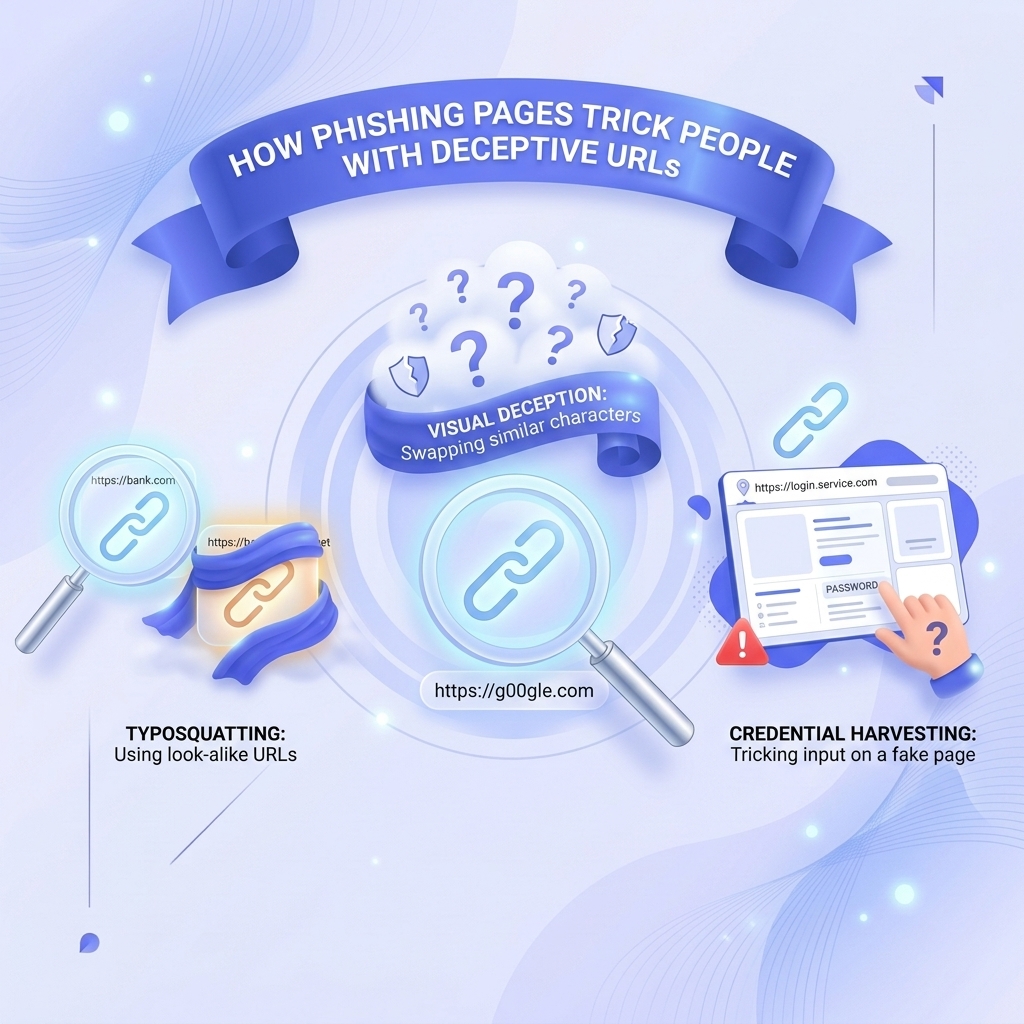
One of the oldest phishing techniques is still one of the most effective: a fake login page. It may imitate your email provider, bank, cloud storage service, social network, or payment processor.
Everything looks normal until you enter your password. Instead of logging in, you have handed credentials to someone else.
Urgency Changes How We Think.
Phishing rarely gives people time to think. It creates pressure so emotion replaces careful inspection.
- Your account will be suspended.
- Immediate action required.
- Verify now.
- Payment failed.
- Security alert.
- Confirm your identity.
- Your package cannot be delivered.
- Someone signed into your account.
HTTPS Does Not Stop Phishing.
Many phishing websites use HTTPS. The connection can be encrypted and the certificate can be valid. Encryption does not prove legitimacy.
A secure connection to the wrong website is still the wrong website.
The Domain Is Often the Biggest Clue.
Attackers know people recognize brand names, so they register domains that feel familiar. Reading the entire domain, not just the logo, is one of the most useful habits you can develop.
- extra words
- added hyphens
- unusual subdomains
- misspellings
- lookalike characters
Redirects Can Hide Intent.
Some phishing campaigns use shortened links, multiple redirects, tracking services, and temporary domains before reaching the final page. Without visibility into those redirects, it is harder to know where you are actually going.
Tracking the Human, Not Just the Click.
Many phishing campaigns track visitors to measure which messages worked, where visitors came from, what browser they use, and which targets are most responsive.
The attack is behavioral as much as technical.
Questions Worth Asking.
- Is this the website I expected?
- Does the domain match the organization?
- Why was I sent here?
- Was I expecting this message?
- Does anything feel rushed?
- Can I verify the destination another way?
Trust Is Built From Multiple Signals.
A trustworthy website is not defined by one indicator. Trust comes from many small observations working together.
- HTTPS is enabled.
- The SSL certificate is valid.
- The domain has existed for years.
- The destination matches expectations.
- Redirects behave normally.
- The website clearly identifies itself.
- No major warning signs appear.
How VennURL Helps.
VennURL does not simply ask whether a link is encrypted. It asks where the link goes, whether it redirects, what website is behind it, whether the SSL certificate looks healthy, whether known warning signs appear, and what a person should understand before opening it.
The goal is not to make decisions for people. The goal is to provide the context they need to make better ones.
Final Thought.
Phishing pages do not usually defeat technology. They take advantage of human expectations.
The best defense is not fear. It is context. When you understand a website before interacting with it, you are already making better decisions.
Understanding comes before action.
VennURL helps people review destinations, context, and warning signs before deciding what to do next.
Related reading
Keep building context with these VennURL notes.
June 20, 2026
Understanding redirect chains
The page you expect is not always the page you reach. Learn how redirects reveal the journey behind a click.
June 20, 2026
Why website age is not everything
An older domain can be reassuring, but domain age should never be the only reason you trust a website.
June 20, 2026
The difference between HTTPS and trust
HTTPS protects your connection. Trust depends on the context that helps you decide whether to connect in the first place.
Continue the Conversation
Follow VennURL for more thoughts on URL intelligence, web trust, and building a calmer internet.